Water in finishing
Wash loads are sized and sequenced to avoid part-full machines, and recipes are set at sampling so bulk does not need reprocessing.

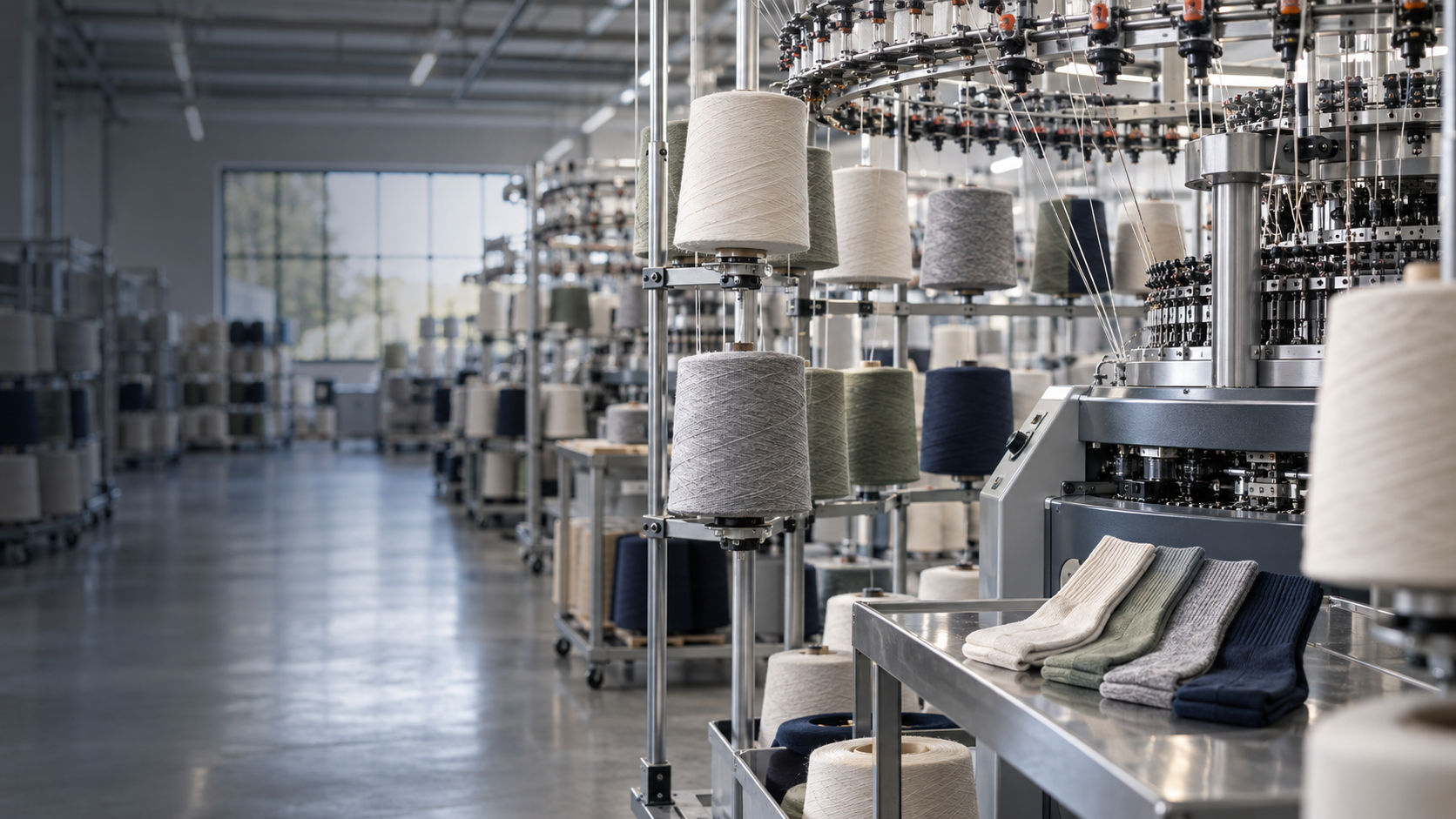
Young Socks approaches responsible manufacturing through material selection, product development, operational improvement, workplace responsibility and documentation aligned to customer requirements.
Responsible progress is not created by a single yarn or certificate. It depends on how materials are selected, products are developed, processes are managed and people are supported throughout production.
We work with customers to identify appropriate material and construction options for each programme, considering product performance, comfort, commercial requirements and available certification pathways.


No single material is appropriate for every sock. Selection depends on the wearer, construction, performance requirement, price point, care expectations and documentation required by the customer.
If you operate collection or recycling at retail, we will supply the material composition data and labelling your scheme needs.
Young Socks maintains an environmental policy within its operations and continues to consider how machinery, materials, finishing processes and production planning affect resource use and operational impact.
Wash loads are sized and sequenced to avoid part-full machines, and recipes are set at sampling so bulk does not need reprocessing.
Boarding and pressing are the heat-intensive stages. Maintenance, insulation and steady scheduling keep consumption per dozen down.
Machine maintenance, efficient lighting and reduced idle running, because a machine set up and waiting still draws power.
Yarn waste and offcuts are collected by fibre type and routed to recyclers, reject causes are recorded and fixed at the machine, and card and paper are separated.
Young Socks maintains environmental, health, safety, social and structural compliance practices aligned with applicable law, customer expectations and audit requirements.
We treat social compliance as a condition of trading rather than a certificate to display.
Wages meet or exceed the legal minimum, are paid on time through recorded channels, and overtime is paid at the statutory rate.
Hours are recorded, overtime is voluntary and capped, and rest days are protected — including in peak season, which is when it matters.
Age verification at hiring, no bonded or involuntary labour anywhere in the operation, and the same expectation applied to suppliers.
Guarding on knitting and linking machines, protective equipment where needed, marked exits and regular fire and evacuation drills.
No discrimination in hiring, pay or promotion, and a grievance route that an operator can use without going through their own supervisor.
Payroll, hours, age and training records are maintained so an audit can be answered from documentation rather than from memory.